Terminalia Festival February 23rd 2018

Well that was a walk, that was,
For we explored boundaries,
Spatial, temporal, linguistic, social, spiritual, rational,
By exploring Jon Seagrave’s Stroud map of the subjective,
Of the emotional and the affective,
Rather than the conventional topography:
The boundary between landscape and experience;

We explored the archaeology of industry:
Rusting capstans and a forgotten railway turntable,
John Seagrave was talking of how the turntable
Could accommodate one wagon at a time only,
For the winch down to the gasworks,
And, oddly, in true time-shift fashion,
I noticed a notelet recently dropped
On the ground nearby:
‘DO NOT DOUBLE STACK’;

Pleased by this coincidence of time and space,
This damp leaf typescript revenant,
Our quickening pace took us back
To 1920s guides to London walking,
Gordon Maxwell and HV Morton;
We planned a Captain Swing memorial walk,
Along the old Tetbury branch line,
To the Trouble House Inn;
We talked of walking the 1839 Newport Rising.

We dropped down Time’s wormholes n so many ways
At the Roman villa at Woodchester,
Where Robin Treefellow transported us
With his fictive account of a servant’s life there,
Druid mistletoe shrouding the lime trees;

Thanks to Deborah Roberts for the above photos – www.deborahroberts.biz

Well that was a walk, that was,
For we explored boundaries,
Spatial, temporal, linguistic, social, spiritual, rational,
By exploring Jon Seagrave’s Stroud map of the subjective,
Of the emotional and the affective,
Rather than the conventional topography:
The boundary between landscape and experience;

We explored the archaeology of industry:
Rusting capstans and a forgotten railway turntable,
John Seagrave was talking of how the turntable
Could accommodate one wagon at a time only,
For the winch down to the gasworks,
And, oddly, in true time-shift fashion,
I noticed a notelet recently dropped
On the ground nearby:
‘DO NOT DOUBLE STACK’;

Pleased by this coincidence of time and space,
This damp leaf typescript revenant,
Our quickening pace took us back
To 1920s guides to London walking,
Gordon Maxwell and HV Morton;
We planned a Captain Swing memorial walk,
Along the old Tetbury branch line,
To the Trouble House Inn;
We talked of walking the 1839 Newport Rising.

We dropped down Time’s wormholes n so many ways
At the Roman villa at Woodchester,
Where Robin Treefellow transported us
With his fictive account of a servant’s life there,
Druid mistletoe shrouding the lime trees;

We walked an ancient track-way,
Courtesy of Bob Fry,
Up a fern filled holloway,
Over iron brown stained springs,
To a Neolithic long barrow,
And subsequent Saxon meeting place,
And boundary marker for the Hundreds,
Where Stuart Butler led us through a linguistic boundary,
To the world of the sacred and the profane;
We toasted Faunus with spoons and wine,
Our libations and offerings to the god,
Bubbling and oddly foaming in the soil’s fissures,
While sky larks ascended with a song;

We discussed how wood anemones could be a palimpsest,
A signpost to forgotten woodland and forest,
As we descended to Selsey Church,
And William Morris stained glass windows,
The early spring light, lustrous,
Streaming over the snowdrops.

We discussed our next two walks,
Both Romano-British in outline,
Sapperton, Oakridge, Bisley and Stroud;
Painswick, Stroud and Rodborough,
With readings from The Mildenhall Treasure,
To entertain and inform,
And studies of Roman maps –
Details to follow.

But as for today,
That was a walk that was,
A magical mystery tour through time and space and language:
That was a walk that was.

North and South

There, on the one hand, St. Pancras and Paris;
And there, on the other, Kings Cross:
Gateway to the LNER,
And night mails crossing the border,

And gateway to a world we have lost:
Pit heads and winding gear, tram-roads and collieries,
And curling smoke chimney stacks:
The world of the North,

The canvas telling the truth,
Up there in the Mining Art Gallery,
At Bishop Auckland:

A terrible beauty down there in the dark depths,
And a beautiful harmony up there in the streets
And homes and chapels and clubs and pubs:
The stippled mist-light of the pit village,
The twisted sinews in the eighteen inch seam,
Ears keening with the creak of each pit prop,
The mind tracking the echo of dripping water,
And the whisper of each rock –

There, on the one hand, St. Pancras and Paris;
And there, on the other, Kings Cross:
Gateway to the LNER,
And night mails crossing the border,

And gateway to a world we have lost:
Pit heads and winding gear, tram-roads and collieries,
And curling smoke chimney stacks:
The world of the North,

The canvas telling the truth,
Up there in the Mining Art Gallery,
At Bishop Auckland:

A terrible beauty down there in the dark depths,
And a beautiful harmony up there in the streets
And homes and chapels and clubs and pubs:
The stippled mist-light of the pit village,
The twisted sinews in the eighteen inch seam,
Ears keening with the creak of each pit prop,
The mind tracking the echo of dripping water,
And the whisper of each rock –

The unspoken fear of entombment,
The threat of explosion;

Eyes quick and darting,

The scent of fire damp,
Methane in the air;

And then there, on another broad canvas,
The women in the kitchen, curlers in the hair,
Stoking up the fire, preparing the bait,
Eyes smarting in the washday steam;

Out there,
Pigeons and whippets and ponies in the field,
Spuds for sale with the Christmas wreaths,
Communal allotments and shared apple trees,

The colliery football teams,
Like West Auckland,
Winners of the first World Cup in 1908 –
They beat Juventus and all,
But didn’t get paid while they were away,

But at least their wives and mothers and sisters
Weren’t grieving at the pithead though,
Grieving for their menfolk,
Trapped down there below,
Bodies trapped and wrapped by the black gold,
The black gold that heated the homes and mansions,
The factories, warehouses, palaces, stations and offices,
The black gold
That powered the smiths, and forges and furnaces,
That powered the trains and shipping lines,
The battleships and the dreadnoughts.

But we were now gazing at a sunset smelted sky
Flaming out over drystone walls and snow capped hills,
And the tumps of old lead mines,

While Christmas lights blazed in the villages,
While pub windows glowed orange in the twilight,
Beyond the nail parlours and tattoo shops,

While we tracked the paths of Charles Dickens,
Wackford Squeers, Smike and Nicholas Nickleby,
Through Barnard Castle and thence to Durham,
Where men and women swopped tales of football,
And where three pints cost six quid,
And where we were allowed to serve ourselves,
While coal, not dole, fires roared in Victorian grates,

Until we went to the People’s Bookshop,
Where books to inspire and educate and value
All line the shelves,
Not priced, but there for a donation,
What you could afford –

And where we talked of a divided ruling class,
And where we talked of victory,
Victory for the working class,
Victory at the next election,
As the sun once more sank in the west;

And so to the Pitmen’s Parliament,
Where a vast audience gathered
Beneath the banners of past struggles and victories,
For a class struggle film of Dennis Skinner,
And talk not just of class,
But of race and gender, too,
Where the ghosts of Socialism past,
Embraced those of Socialism Present and Future,
A world not so much as lost,
As a paradise waiting to be regained,
A union of North and South:

‘Oh, Jeremy Corbyn.’

‘In the bar room, in the bar room,
That’s where we congregate,
To drill the holes, shovel coals and shovel up the slate,
And for to do a job of work,
Oh, I am never late,
That’s provided we can do it in the bar room.’

Bristol: Clichéd Football; Radical History

Temple Meads via Swindon, 14 quid?
Temple Meads via Gloucester, only 7?
Well, that meant a ride through the warehouse edgelands,
And the buddleia rusting railway lines to Gloucester
(‘YES MATE’, as it said under the bridge),
But there was time enough for a trip down football’s memory lane
With a Swindon fan at Stroud:
‘No football at Ebley, now, look.
Nothin’.
Nothin’ at Ebley anymore’
I said I was off to watch Derby at Bristol City,
And he recalled
Swindon beating Derby one nil,
November 5th 1968:
‘Best Bonfire Night I ever had.’
We talked of FGR:
‘You be careful at Forest Green on Friday.
I know about 200 Swindon fans will be at the FGR end.’
‘I know mate. I’ll be one of them. With my red and white scarf.’
He looked at me with new and slightly befuddled admiration.
He slapped me on the back:
‘Fair play on ya, mate. Fair play.’

Temple Meads via Swindon, 14 quid?
Temple Meads via Gloucester, only 7?
Well, that meant a ride through the warehouse edgelands,
And the buddleia rusting railway lines to Gloucester
(‘YES MATE’, as it said under the bridge),
But there was time enough for a trip down football’s memory lane
With a Swindon fan at Stroud:
‘No football at Ebley, now, look.
Nothin’.
Nothin’ at Ebley anymore’
I said I was off to watch Derby at Bristol City,
And he recalled
Swindon beating Derby one nil,
November 5th 1968:
‘Best Bonfire Night I ever had.’
We talked of FGR:
‘You be careful at Forest Green on Friday.
I know about 200 Swindon fans will be at the FGR end.’
‘I know mate. I’ll be one of them. With my red and white scarf.’
He looked at me with new and slightly befuddled admiration.
He slapped me on the back:
‘Fair play on ya, mate. Fair play.’

I watched the world go by at Gloucester for a while,
A goods train trundled through:
60091, Barry Needham,
Named after a coal train controller:
Barry died tragically in a railway accident,
Giving his time freely, on a day off –
His mates paid for the nameplate …

I read some Ian Sinclair through the Severn Vale
(Old trainspotting terrain with my brother),
Thinking I could divine Ian Sinclair’s style:
Minute description; simile; recent fact; historical fact;
Slightly occult reference; minute description …
OMG,
Is this what we all do?

We rattled through the suburbs of Bristol
To reach Temple Meads,
Middle class pasty at Harts,
Then a ferry to Hotwells, by the Nova Scotia,
To walk past the beer-fuelled Derby fans:
‘We are Derby, Super Derby, Super Derby, Super Rams’,
And so a tryst at the John Atyeo statue,
A sight of police with guns (Parsons Green),
And an open end to end game of two halves
(‘May the best team win!’),
0-1 after 45 minutes,
4-1 after 90 –
Sometimes the clichéd games are the best:
There’s a reason for a cliché, isn’t there?

The next day I walked past St. Mary Redcliffe
(Coleridge and Chatterton and Old Rowley –
And bells ringing to celebrate the defeat of a slavery abolition bill),
Past The Ship and Colston Parade,
To reach the Docks, the MSHED,
And the Bristol Radical History Festival
(‘Countering Colston’):
A wonderfully vibrant day where kindred spirits,
Like minded activists, historians, performers, walkers,
Artists, speakers, poets, writers and puppeteers
Presented a different view of the past:
History from below,
Authentic history,
History that goes beyond the clichéd:
For while a cliché might suffice
When describing a train journey,
Or a football match –
Real and Radical History
Takes you beyond the cliché of Heritage:
It cleanses your perception,
It opens doors,
To momentarily extinguish
‘The guttering candle’
Of clichéd Heritage;
Then illuminates the darkness
With a Captain Swing blaze of truth.

Stroud Fringe Walk: Place, Space and Time

Beneath the pavement, the beach! For here we have a line of houses called Streamside, And up there, beyond the Fountain pub, Lies Springfield Road and a plethora Of constant, subterranean springs, Springs! The genius loci of Stroud …

We walked down Lansdowne, To cross the Slad Brook, at Mill House, In search of the edgelands, Puddles, brooks and panel beaters, Car dealers, buddleia, car parks and cinemas, Past the Dickensian Omar L. Cottle, Monumental mason, The nominative determinism of a park, Named after a Park, Past strange continuities in the street: The chemist’s on the corner, Where in 1872, A chemist by the name of Joseph Banks Campaigned for a farm workers’ trade union, And no more payment in truck: ‘In sterling money, not fat bacon …or a couple of swedes’,

Then to Badbrook and weavers’ riots, ‘We had been working ever longer time for ever cankered pennies all the year. Something needed doing. So we laid our shuttles and looms to rest and joined the Stroud Valleys Weavers Union. This is my true and faithful account. I cannot dissemble. The Good Book tells us that we should get our bread by the sweat of our brow. We had the sweat but no bread. What could we do?’

Thanks to Peter Bruce for the above images.

Beneath the pavement, the beach! For here we have a line of houses called Streamside, And up there, beyond the Fountain pub, Lies Springfield Road and a plethora Of constant, subterranean springs, Springs! The genius loci of Stroud …

We walked down Lansdowne, To cross the Slad Brook, at Mill House, In search of the edgelands, Puddles, brooks and panel beaters, Car dealers, buddleia, car parks and cinemas, Past the Dickensian Omar L. Cottle, Monumental mason, The nominative determinism of a park, Named after a Park, Past strange continuities in the street: The chemist’s on the corner, Where in 1872, A chemist by the name of Joseph Banks Campaigned for a farm workers’ trade union, And no more payment in truck: ‘In sterling money, not fat bacon …or a couple of swedes’,

Then to Badbrook and weavers’ riots, ‘We had been working ever longer time for ever cankered pennies all the year. Something needed doing. So we laid our shuttles and looms to rest and joined the Stroud Valleys Weavers Union. This is my true and faithful account. I cannot dissemble. The Good Book tells us that we should get our bread by the sweat of our brow. We had the sweat but no bread. What could we do?’

On past the culverted brook, Mcdonald’s, (Who owns the brook?) Edgelands car park signage, Underneath the dirty old town railway viaduct, Along the canal, past old turnpike gates, Behind Lodgemore Mill, past sluice gates and leats, Listening to the voices of the dispossessed, ‘I was baptized Josephine, but I call myself Joe now: I never felt comfortable in a woman’s clothes … a professional legger, An inland navigator of sorts, a sort of hybrid, My sex hidden by fustian, and the subterranean Depths, down there where the fossils remind us Of Noah, the ark, the deluge, and the dove of peace.’ Past old mill buildings – there a self storage centre – Past fences with endless toppings of rolled barbed wire, Past Springfield Cottage, along the Cainscross Road, Skirting the site of the toll house riots, Along suburban footpaths that could be Saxon, Or even prehistoric in provenance, Linking lines of hills and valleys, An edgelands liminal palimpsest … Past more streams and springs at Puck’s Hole, To reach Bread Street and hear of the 1766 food riots, ‘Many that are under sentence of death thought they were doing a meritorious act at the very moment they were forfeiting their lives’,

And so down dale and uphill to sit for study (A silent group gathered on the pasture) Randwick’s 1832 experiment of dispensing with money; Gazing up to the village’s labyrinth of footpaths, Built in exchange for raiment, food, bibles and tokens, ‘Personal Decency promoted, AND IMMORALITY CHECKED, Exchanging Men’s idle time for the Blessings of Food and Raiment. Randwick 1832.’ And thence past Callowell, (so many watery names!), More springs, And the ghost of a turnpike bar at Salmon Springs, Through Stratford Park, past its museum, And narrow gauge railway, To exchange addresses and reflect on Rebecca Solnit – The meaning of our pilgrimage: ‘We think space is about place, in fact it is really about time.’

Thanks to Mark Hewlett for the below image:

Radical Pub Crawl: Loomsday

A pub-crawl is something I associate
With my youth – indeed, I have never ever
Typed ‘pub crawl’, before, but I am surprised
To find a green line advising me to
Hyphenate and create a compound noun.

The word was never hyphenated
When I used to go on a pub crawl:
There was a noun and there was a verb,
The noun was a sort of synecdoche,
Whilst the verb ‘crawl’ said it all:
The evening started vertical
And ended with a slow, meandering
Horizontal, hands and feet slowly,
Gradually, inching along pavement.

And that was a pub crawl, sampling lots of
Different pints, and different pubs,
Different prices, and atmospheres,
Collecting and clocking the pub names,
The different tastes, strengths and breweries,
In a sort of localised and active
Sociological nuanced survey:
It made you observant through the smoke.

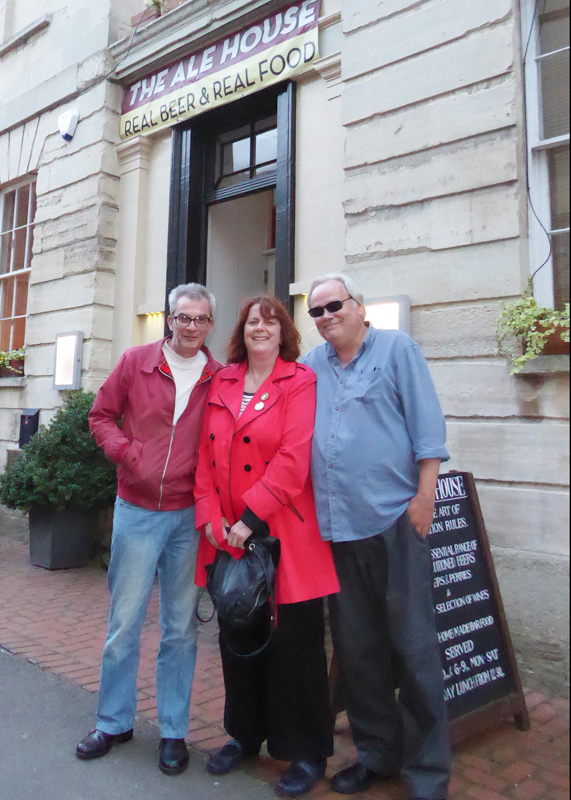
Thanks to Deborah Roberts for the above photos.

A pub-crawl is something I associate
With my youth – indeed, I have never ever
Typed ‘pub crawl’, before, but I am surprised
To find a green line advising me to
Hyphenate and create a compound noun.

The word was never hyphenated
When I used to go on a pub crawl:
There was a noun and there was a verb,
The noun was a sort of synecdoche,
Whilst the verb ‘crawl’ said it all:
The evening started vertical
And ended with a slow, meandering
Horizontal, hands and feet slowly,
Gradually, inching along pavement.

And that was a pub crawl, sampling lots of
Different pints, and different pubs,
Different prices, and atmospheres,
Collecting and clocking the pub names,
The different tastes, strengths and breweries,
In a sort of localised and active
Sociological nuanced survey:
It made you observant through the smoke.

But it’s back to the future, this afternoon,
Our inaugural Stroud Loomsday pub crawl:

The day might well turn out to be a dream
Of modernist stream of consciousness,
A right, regular James Joyce Bloomsday,
An odyssey through space, time and language,
Avant-garde as well as avant-bard,
A cyclical Finnegans Wake of a
Self-referential, post-modernist pub crawl,
A Stroud Loomsday interweaving of tales,
Homespun yarns, birthdays, anniversaries:
John Clare Day, Bastille Day, St Swithin’s Day,
Edward Thomas enlisting, and writing
‘For These’: his justificatory poem –

Or we might just chew the cud and ruminate,
Silently studying the life and times,
The sociology and semiology
Of Stroud town pubs on a Thursday in July:
The Fountain, the Greyhound, the Imperial,
The Lord John and the SVA,
Slad Road, Gloucester Street, Russell Street,
Lansdowne, John Street, George Street, King Street,
Reading and reciting, drinking and inciting,

Or we might, I dunno, just have a drink,
And follow Wikepedia’s definition:
A pub crawl (sometimes called a bar tour, bar crawl or bar-hopping) is the act of drinking in multiple pubs or bars in a single night, normally travelling by foot or public transport to each destination and occasionally by cycle …

In the UK, pub crawls are generally unstructured and spontaneous nights-out, in which the participants arrange to meet in a particular location and decide over drinks on where to drink next. Structured routes with regular stops are rare. Most drinking sessions based around a special occasion such as a birthday or a leaving celebration will involve a pub-crawl, often with the group splitting up but agreeing on meeting at the next location. It is a common sight in UK towns to see several groups orbiting the various drinking locations with little apparent coherence or structure …

Discoveries:
1. Sitting outside in the garden at the Fountain is a delight: late Victorian/Edwardian red brick and Cotswold stone surroundings and views. Very atmospheric. Recommended.
2. You can get a beer called Odyssey at the Vic: most suitable indeed for a James Joycean pub crawl. Again, sitting outside is recommended.
3. The Greyhound has astonishing Edwardian urinals – adamantine, as it were.
4. Sitting outside at the Imperial is a great prompt for railway reflections, and ruminations on Stroud’s architectural heritage (See below*). Recommended.
5. The Lord John is enormous and a bit of a theatre of dreams. Again, sitting outside is recommended. You can fit in 10,000 steps just walking around the pub.
6. The SVA is another recommended outside watering hole.

Holloway House and the discovery of the fasces:
I can’t believe no one has noticed this before. We stared at it, noted it, then questioned it, on our inaugural Loomsday pub crawl: the Vic, the Fountain, the Greyhound, the Imperial, Lord John, and finally, the SVA.
Sorry couldn’y join you today. Is it technically a fascisti if no axe?
Mmm. I think you may be right in the sober light of dawn, Paul. Just as beauty is in the eye of the beholder, so fascism is in the eye of the pub crawler. We had a great time! Hope you had a great birthday. No hangover!
A little light research on wikkipodium thing reveals that the bundle of sticks symbol (symbolizing strength through unity) does not always contain an axe. However, it is used far more widely than in a fascist context. See attached pic of Lincoln memorial for example. A very popular symbol…
.
* Fasces as an architectural device have a number of nuanced significations. Here it possibly alludes to the collective qualities of Mid-Gloucestershire Working Men’s Benefit Society? Fasces also appear frequently in America’s iconography including on Washington’s memorial. George W had his flaws I believe but was not predominantly fascist.
I’m trying to maintain a generous view of Mr Holloway against the day that I may be asked to declaim his socio/economic thoughts with sincerity and conviction for dramatic purposes. As Stan might have said, you have to wear the character. Of course, you can also wear out a character, besides life is short.
* Thank you Mr Hicks. A little sober research this morning has revealed that the fasces do indeed have a wide use as you say. Have included a pic of the Lincoln Memorial to illustrate.
* You’re right to correct me (implicitly) Bob. I’m conflating Lincoln’s memorial with Washington’s statue. Both have fasces, if anything Washington’s is proportionately bigglier. Probably the biggliest till Trump proves, beyond doubt, he’s mortal.
*Gosh! That’s a big one!
* All good stuff. Thanks Bill and Bob. But after a couple of pints, there’s a distinct Il Duce vibe about it all. What’s the moral?
* Not a moral issue old chum. Delusional insobriety is like a runner’s stitch, you have to drink your way through it. Il Duce was an old hand at the technique.

NEXT LOOMSDAY CRAWL WILL START AT THE LITTLE GEORGE. DATE TO BE CONFIRMED.

NOT ONE DAY MORE: Overton’s Window

I’ve just come across the term ‘Overton’s Window’,
In an article by Owen Jones,
Also called the ‘Window of Discourse’:
The way ideas are viewed by the public,
In a spectrum of judgement that runs from
The Unacceptable, to the Radical, the Acceptable,
The Sensible, the Popular,
And finally: Policy.

It’s obvious that the way this window –
Or Zeitgeist –
Is now defined,
Has been revolutionised
By social media, activists and clicktivists,
While any notion of ‘the public’
Must now accommodate a whole new Generation Y:
The dispossessed millennials are taking the reins –
Paul Dacre and Rupert Murdoch and co.
Can still ride roughshod,
But only in their own heft now.

It’s a weird thing for me,
Someone who first read Marx nearly fifty years ago,
Someone who has been marginalised
By mainstream orthodoxy’s definition of common sense
For nearly half a century,
To see a 2017 Labour party political broadcast,
Where a voice demands the full fruits of her labour:
The revolution will be televised!
So this Saturday’s demonstration:
NOT ONE DAY MORE
#TORIES OUT NO MORE AUSTERITY,
Hosted by The People’s Assembly Against Austerity,

I’ve just come across the term ‘Overton’s Window’,
In an article by Owen Jones,
Also called the ‘Window of Discourse’:
The way ideas are viewed by the public,
In a spectrum of judgement that runs from
The Unacceptable, to the Radical, the Acceptable,
The Sensible, the Popular,
And finally: Policy.

It’s obvious that the way this window –
Or Zeitgeist –
Is now defined,
Has been revolutionised
By social media, activists and clicktivists,
While any notion of ‘the public’
Must now accommodate a whole new Generation Y:
The dispossessed millennials are taking the reins –
Paul Dacre and Rupert Murdoch and co.
Can still ride roughshod,
But only in their own heft now.

It’s a weird thing for me,
Someone who first read Marx nearly fifty years ago,
Someone who has been marginalised
By mainstream orthodoxy’s definition of common sense
For nearly half a century,
To see a 2017 Labour party political broadcast,
Where a voice demands the full fruits of her labour:
The revolution will be televised!
So this Saturday’s demonstration:
NOT ONE DAY MORE
#TORIES OUT NO MORE AUSTERITY,
Hosted by The People’s Assembly Against Austerity,
Feels as though the trip from Stroud to London,
Might, this time, look different from the carriage window:
A left wing journey to the centre of the capital,
Not through moderation, compromise and trimming –
But through redefining ‘common sense’,
Aka ‘the practical wisdom of the ruling class’ –
A journey through the Slough of Despond,
To Old Oak Common,
Past Paddington’s hidden Tyburn Tree,
To Portland Place and the BBC,
To Westminster Bridge, where,
‘Earth has nothing to show more fair’:
‘Rise like lions after slumber,
In unvanquishable number’:
‘From each according to their ability,
To each according to their needs.’


And when we got there … it was like something out of William Blake: we wandered through London’s chartered streets, with songs of innocence and experience, with anger and lament for Grenfell Tower, every step along the pavements and the reclaimed chartered streets, a step upon austerity’s mind-forged manacles, a step through a theatre of dreams, possibilities, and practicalities, a kaleidoscope of banners, flags and wit: a new Window of Discourse right there in Parliament Square, where Jeremy Corbyn spoke for nearly half an hour with all the command of the art of the rhetorician, but from the heart, too, with passion and with sincerity – as new spectrums of light danced around the windows of Westminster.

The flags, banners and balloons danced in the air near the chartered river too: Not One Day More; Tories Out; For Health Homes Education JC4PM; Austerity isn’t Working; Austerity Kills Justice for Grenfell; I’m So Fucking Angry; A Theresa May lookalike: We Cut 10,000 Fire-fighters Jobs Because Your Lives Are Worth Less; trade union banners and balloons; Strong and Stable?; Capitalism Kills; Thatcher in the Rye; Rise Like Lions after Slumber; LGBT Rights Human Rights; Kick the Tories Out; Defy Tory Rule; Workers of the World Unite; Austerity is the New Terror Your Country Needs You War on Austerity; Justice for Grenfell; Latinxs con Corbyn; Theresa DisMay; May DUPed the Country; Organise Strike Resist; Cut War not Welfare; No to Islamophobia No to War; Flags of love danced around Big Ben – as new spectrums of light danced around the Overton’s Windows of Westminster.

I carried my banner from Stroud to Westminster with pride, inviting conversations along the way, leaving a trail of old ladies in Stroud lamenting May in Middle Street, discussions of anger and frustration at privatisation and cancelled trains in the packed waiting room at Swindon, thumbs up and car beebs as I ran from Paddington to Oxford Street to march with my parents. As we heard the chants as Corbyn came on stage, I asked my 67 year old dad, have you ever heard another politician have their own song and he said “not in my lifetime” The collective energy on the march was tangible and it’s quite something to be part of this.

Essia Harding


Momentum Is The New Chartism

When the Daily Express and the Daily Mail tried to control
The Prime Minister, Stanley Baldwin, back in the thirties,
He commented in his masculine way:
‘What the proprietorship of these newspapers is aiming at is power,
But power without responsibility,
The prerogative of the harlot throughout the ages.’
In the 2016 referendum,
We had Arron Banks:
‘Facts don’t work, and that’s it …
It just doesn’t work.
You have to connect with the people emotionally.
It’s the Trump success.’
And the General Election of 2017?
The Sun, Daily Mail, Daily Telegraph, Daily Express,
With their slew of headlines,
Make it difficult not to think of John Heartfield,
And his Weimar agit-prop:
Big business pulling Hitler’s puppet strings;
What a coincidence that Boris Johnson should speak on the very subject
Of Jeremy Corbyn’s ‘soft on terrorism’ trope,
The very day before The Sun, Daily Mail, Daily Telegraph, Daily Express
Splashed their similar views all over their front pages –
I think this means that we now have a new category
Of political system for the text book:
A liberal-democratic 21st century variant of Fascism:
‘Strong and Stable Government’; ‘Coalition of Chaos’; ‘Brexit means Brexit’;
‘We make no apology for drawing attention to the fact that Jeremy Corbyn
has spent a lifetime siding with people who want to do Britain harm,
would weaken our defences and make our country less safe …’.

(The 2017 General Election)

When the Daily Express and the Daily Mail tried to control
The Prime Minister, Stanley Baldwin, back in the thirties,
He commented in his masculine way:
‘What the proprietorship of these newspapers is aiming at is power,
But power without responsibility,
The prerogative of the harlot throughout the ages.’
In the 2016 referendum,
We had Arron Banks:
‘Facts don’t work, and that’s it …
It just doesn’t work.
You have to connect with the people emotionally.
It’s the Trump success.’
And the General Election of 2017?
The Sun, Daily Mail, Daily Telegraph, Daily Express,
With their slew of headlines,
Make it difficult not to think of John Heartfield,
And his Weimar agit-prop:
Big business pulling Hitler’s puppet strings;
What a coincidence that Boris Johnson should speak on the very subject
Of Jeremy Corbyn’s ‘soft on terrorism’ trope,
The very day before The Sun, Daily Mail, Daily Telegraph, Daily Express
Splashed their similar views all over their front pages –
I think this means that we now have a new category
Of political system for the text book:
A liberal-democratic 21st century variant of Fascism:
‘Strong and Stable Government’; ‘Coalition of Chaos’; ‘Brexit means Brexit’;
‘We make no apology for drawing attention to the fact that Jeremy Corbyn
has spent a lifetime siding with people who want to do Britain harm,
would weaken our defences and make our country less safe …’.

Nearly two centuries ago,
Five thousand Chartist supporters met on Selsley Common,
Affirming their support for working class political power,
Through the Six Points,
Five of which have become law:
Secret Ballot (1872); Equal Constituencies (1885); Universal Franchise (1928);
Abolition of Property Qualification to stand as an MP (1858);
Payment of MPs (1911);
Annual Parliaments;
It was thought that this would usher in democracy,
But the transgressions of our so called free press
(Remember the Zinoviev Letter forgery in the Daily Mail at the 1924 election?
The Daly Mail has got a long history and a lot of previous),
Mean that those points have been nullified:
The ballot is no longer secret – voters’ heads are full of lies
(Or ‘cultural hegemony’ as Gramsci put it,
Or ‘false consciousness’, as Marx put it);
The next constituency redrawing will favour the Conservatives
In their bid to establish a one party state;
Many people have forgotten the struggles of men and women:
Imprisonment, hunger strikes, death, transportation,
Or they’ve not been taught about it, or listened,
And abstain on principle,
Or vote ‘on principle’,
Or forget to vote …
MPs are unrepresentative of the population,
Even with 51% of the new intake educated at comprehensives …

The Chartists could not imagine a world where money talks so persuasively:
They thought votes for all would mean equality of power,
Where one vote is worth the same as another,
And where the voter was free from coercion, intimidation and control:
But what we have today is not democracy,
It is a liberal-democratic variant of fascism,
A stepping-stone towards a one party state,
Where Brexit might not just mean Brexit,
But also mean a form of totalitarianism;

But Momentum,
With the new wave of young activists in the Labour Party
Are the new Chartists:
The Chartists of the twenty first century,
People who remind us that we can control history,
We can fight back against the lies of the press,
We can prevent a liberal-democratic fascism,
We can establish socialism,
We can fight back,
‘For the many, not the few”,
Carrying the mantle of Shelley’s rage against Peterloo,
And the dictatorial Six Acts:
‘Ye are many – they are few!’

And in tune with this noble democratic tradition…
The Politics Kitchen initiative on Stroud High Street –
The inspiration of Skeena Rathor –
Is centrally about recognising and empowering
The forces of the heart
In our broken political system.
A return to “3-D politics” –
Face-to-face, body-to-body –
Heart-to-heart, relational politics.
A deep democracy that is both
Witness and friend.

Rodborough, Sunday June 11th

Rodborough, Sunday June 11th

A year ago we wandered through the sculptures
And hidden gardens of Rodborough,
Depressed and stupefied after the referendum result,
Lowering clouds gathering over the Severn,
Proving that the notion of a pathetic fallacy is not a fallacy –
But this year, the sun shone on the sculptures,
The flowers were particularly and pleasantly fragrant,
The tea and cake taken in the church graveyard,
Tasted sweetly of the resurrection of Labour,
And the party in the Prince Albert

Rodborough, Sunday June 11th

A year ago we wandered through the sculptures
And hidden gardens of Rodborough,
Depressed and stupefied after the referendum result,
Lowering clouds gathering over the Severn,
Proving that the notion of a pathetic fallacy is not a fallacy –
But this year, the sun shone on the sculptures,
The flowers were particularly and pleasantly fragrant,
The tea and cake taken in the church graveyard,
Tasted sweetly of the resurrection of Labour,
And the party in the Prince Albert
Showed Stroud at its inclusive best:
A complete cross section of society,
In a happy harmony of delight,
A heaven where ambrosia and nectar were shared equally,
By friends, families and strangers,
And where everyone was a comrade:
David Drew and family laid on a spread
To thank all supporters and workers,
People spoke of past elections and struggles,
David’s seven general election results
Were attached to the beer pumps
In a panoply across the bar,
The front door of the pub was garlanded
With a red and white banner:
‘Thank You’,
The chimney breast was covered with the banner
Of the Stroud Constituency Labour Party,
Lottie and Miles served tea and cake,
David ran a tab at the bar,
People spoke of their Thursday tears of joy,
David spoke of his commitment to the manifesto,
Everyone stood to applaud him –
But John Bloxsom reminded us
That there is another election ahead:
So while we celebrate in the carefree present moment,
We know that we prepare for the future:
But time is an illusion on a sun splashed Stroud afternoon,
For this is a new dawn –
This truly is a new dawn.

Bakanalia Border Morris by Deborah Roberts
Labour Party Banner by Deborah Roberts
Rodborough Sculpture by Deborah Roberts

Credit to Deborah Roberts for the above photos.

Rodborough Church by Bob Fry

Credit to Bob Fry for the above photo.

Not Bad for a Village Team

Tranmere –
The name suggests a crossing of the waters,
A ferry across the Mersey,
A crossing of the River Rubicon,
Or for us, the River Thames –
On the 9.55 Football Poets Special,
Speeding through the Golden Valley,
Past Swindon’s railway works,
The Vale of the White Horse,
Then on through Sonning Cutting,
Sequestered Berkshire,
Suburban Middlesex,
Old Oak Common,
To Paddington.

Tranmere –
The name suggests a crossing of the waters,
A ferry across the Mersey,
A crossing of the River Rubicon,
Or for us, the River Thames –
On the 9.55 Football Poets Special,
Speeding through the Golden Valley,
Past Swindon’s railway works,
The Vale of the White Horse,
Then on through Sonning Cutting,
Sequestered Berkshire,
Suburban Middlesex,
Old Oak Common,
To Paddington.

We sat in an overcrowded carriage:
Richard, now ready, having scoured Stroud,
And all villages and hamlets of the Five Valleys,
Until at last finally securing an FGR scarf,
Chewing on his bacon and egg sandwich,
But worried that he’d left the gas ring on,
Stuart, with a stone in his shoe from his yesterday walk,
Seeing it as a pilgrim’s scruple,
The retention of which would be necessary for victory,
For only the scrupulous would be triumphant,
After enduring self-flagellation,
Crispin, now ready, after tirelessly badgering
Wembley Stadium about his treasured, magic drum –
More of that later.

But there we were,
At Wembley,
Like a village gawping at the big city,
Just 3,500 souls,
Thirteen charabancs only
(Six from FGR, 4 from Stroud, 3 from Stonehouse),
Like some Laurie Lee
Cider with Rosie day out revisited,
A Last Supper of the Season,
While the massed ranks from Birkenhead and Liverpool
Numbered 15,000 and fifty coaches,
Confident of victory,
Against this rustic outfit.

But Crispin had a plan –
Crispin Thomas, like Oscar,
The clairaudient in The Tin Drum,
Worried that Wembley would ban his drum:
‘the day will come …
oh how I pray
for my white drum’,

Eventually receiving this email from Wembley Stadium:

Hello Crispin,

I hope you are well. This isn’t a problem and the staff are aware of you and your drum.
Please make your way to the accessible entrance at the turnstile and they will check the drum and they will let you in.
Many thanks,

Crispin, now ready,
Crispin,
Now revelling in his clairaudient condition,
Obtaining a ‘singing end’ for FGR,
Joining ranks with the other FGR drummer,
To wave his arms in the air to draw the FGR crowd
From their numbered, specified seats,
And so amplify the support, noise and chants,
With supporters standing en masse behind the goal,
Despite the tickets stating in bold:
Persistent standing is not allowed.

But we were allowed,
Because all fans behaved themselves responsibly –
But many thanks to Wembley’s staff for their dispensation,
For this concentrated noise
Gave succour to the team on the pitch
Throughout the whole ninety minutes:
The support was continuous.

And at the end,
After all the chants of
‘On our way, on our way,
To the football league we’re on our way’,
And,
‘Not bad for a village team,
Not bad for a village team’,
The man from the Met. came up to Crispin,
Congratulated him on his drumming,
Congratulated FGR’s three and a half thousand
For outshouting Tranmere,
Adding,
‘I had a tear in my eye at the end.
I was so pleased for you.’

Not bad for a village team,
A team at the top of a hill in the middle of nowhere.

Painswick Beacon and Botany Bay

The solstice is a time for wonder and the imagination,
But sometimes you need facts, figures and measurements:
Lines of latitude and longitude – maritime chronometers too,
Were needed for New South Wales and Van Diemen’s Land,
For those weavers, cloth-workers, hatters, labourers and servants,
Transported as convicts, far distant from their Painswick homes,
On ships such as the Emma Eugenia, Florentia, Lady Ridley,
Duncan, Gilmore, Persian, Lord Hungerford, Bengal Merchant;
People such as Ann Alder, Henry Beard and Samuel Beard,
John Birt, Isaac Estcourt, James Green, William Haines, Charles Cook;
And at winter solstice-tide, we gathered at Painswick Beacon,

Thanks to Deborah Roberts for the above Photo.
www.deborahroberts.biz

The solstice is a time for wonder and the imagination,
But sometimes you need facts, figures and measurements:
Lines of latitude and longitude – maritime chronometers too,
Were needed for New South Wales and Van Diemen’s Land,
For those weavers, cloth-workers, hatters, labourers and servants,
Transported as convicts, far distant from their Painswick homes,
On ships such as the Emma Eugenia, Florentia, Lady Ridley,
Duncan, Gilmore, Persian, Lord Hungerford, Bengal Merchant;
People such as Ann Alder, Henry Beard and Samuel Beard,
John Birt, Isaac Estcourt, James Green, William Haines, Charles Cook;
And at winter solstice-tide, we gathered at Painswick Beacon,
Latitude 51°48’27″N and longitude 2°11’44″W; 283m / 928ft.,
SO 86836 12076, ready for sunrise at 8.14, on the 22nd of December,
A dozen of us, to welcome the mid-winter dawn,
Close by an Iron Age hill fort,
The ghosts of our prehistory all around the scarp,
(At a beacon: ‘from the Saxon’,
Meaning a sign, portent, light, lighthouse,
A source of light or inspiration),
Welcoming the first lengthening day of the season,
As it spread its light and inspiration
Over the Malverns, the Cotswolds, the sinuous River Severn,
Over a landscape etched with names and signs and portents
Such as Ongers, Kimsbury, Paradise,
Spoonbed Hill, Kites Hill, Popes Wood, Saltridge Hill, Cud Hill,
Holcombe, Brentlands, Podgewell, Bacchus –
Distant memories for our exiled Painswick ancestors,
Their ghosts gathered to witness farewell
To the longest day of the year,
Near Botany Bay,
33.9930° S, 151.1753° E …
But today,
We reunited them with their landscape,
And their history,
With a toast to their memory and to the sun:
Painswick Beacon, Botany Bay,
New South Wales and Van Dieman’s Land,
Mid-winter and mid-summer conjoined,
With solstitial imagination,
A lighthouse of time and space.